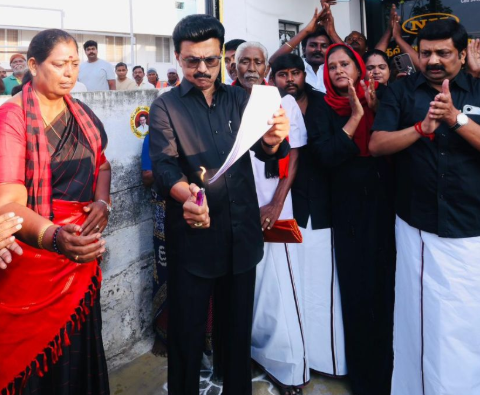
In New Delhi on Thursday, the argument was framed as legislative housekeeping. In much of South India, it landed like a warning siren.
With the introduction of the Delimitation Bill, 2026 in the Lok Sabha on 16 April 2026, alongside the Constitution (131st Amendment) Bill, 2026 and the Union Territories Laws (Amendment) Bill, 2026, Parliament did not merely table another technical reform. It revived one of the most combustible questions in Indian federal politics: when representation is recalculated, who pays the price?1 2 3
For the Union government, the answer is principled and constitutional. India, it says, cannot keep pretending that the population map of 1971 should indefinitely determine the voice of the Republic in 2026. For many in the South, the answer feels less like constitutional housekeeping and more like political retribution. They believe the very states that moved earliest on population stabilisation, female education, and social development are now being told that their reward for getting policy right is diminished influence in Parliament.
That is why the Delimitation Bill is not just about constituencies. It is about arithmetic, memory, federal suspicion, and the uneasy question of whether democracy as equal population representation can coexist comfortably with federal fairness among unequal states.
The story behind Delimitation Bill
To understand why the debate feels so charged, one has to begin with a compromise India made half a century ago. The Constitution originally required that seats in the Lok Sabha be allocated to states in proportion to population and that constituencies be periodically redrawn after every census.1 2 But in 1976, during a very different political era, the country froze the state-wise allocation of seats using the 1971 Census as the baseline. The purpose was explicitly political and developmental: states should not be punished for pursuing population control.1 2
That freeze was not meant to last forever. It was first imposed through the 42nd Constitutional Amendment and later extended by the 84th Amendment in 2001 until after the first census following 2026.1 2 For decades, that arrangement kept a fragile peace. High-growth northern states remained under-represented relative to current population, while lower-growth southern states did not have to fear a shrinking share of national representation.
Now that truce is expiring.
PRS Legislative Research notes that the Delimitation Bill, 2026 provides for the constitution of a Delimitation Commission, while the accompanying constitutional amendment would restore the principle that Lok Sabha seats should again be tied to population, authorise Parliament to decide by law when delimitation will occur and which census will be used, and raise the constitutional ceiling of the House from 550 to 850 members, including up to 815 from states and 35 from Union Territories.1 2
That last detail matters enormously. This is not simply a redrawing of maps. It is potentially a redesign of the size and political balance of the lower house itself.
Why the South heard an alarm bell
The fear in South India is not imagined, and it is not merely emotional. It is numerical.
PRS’s published projections show that if the Lok Sabha remained close to current strength and seats were redistributed using the 2011 Census, some southern states would lose seats outright. Tamil Nadu would fall from 39 to 32 seats, Kerala from 20 to 15, Karnataka from 28 to 27, and Andhra Pradesh, counted along with Telangana in the PRS note, from 42 to 38. Meanwhile, Uttar Pradesh would rise from 80 to 89, Bihar from 40 to 46, and Rajasthan from 25 to 30.3
Even under a much larger Lok Sabha, where total seats increase by roughly 50 percent, the anxiety does not vanish. In that projection, Tamil Nadu rises to 48 seats and Kerala to 22. Yet their importance within the chamber still declines because their share drops. Tamil Nadu’s share falls from 7.18 percent to 5.90 percent, while Kerala’s drops from 3.68 percent to 2.71 percent.3
That distinction between absolute gain and relative loss explains much of the political heat. A government can truthfully say that a state has more MPs than before, while critics can just as truthfully say that the state’s power in the Lok Sabha has weakened.
| State | Current seats | PRS projection if near-current House strength | PRS projection if House expands by ~50% | What matters politically |
| Tamil Nadu | 39 | 32 | 48 | Gains in a larger House, but loses share3 |
| Kerala | 20 | 15 | 22 | Slight absolute gain in expanded House, but lower share3 |
| Karnataka | 28 | 27 | 41 | Little change in one scenario, but share pressure remains3 |
| Uttar Pradesh | 80 | 89 | 133 | Large increase in both number and share3 |
| Bihar | 40 | 46 | 69 | Significant rise in representation3 |
From Chennai to Thiruvananthapuram to Hyderabad and Bengaluru, the argument has therefore been simple: why should states that followed the Centre’s own population-control logic end up less powerful in the national legislature?
A South-focused commentary published today distilled the sentiment sharply. The anxiety, it argued, comes from the fear of a demographic penalty: the idea that states which invested earlier in public health, social reform, and fertility decline are now being made to absorb the political cost of that success.7
The Centre’s answer begins from a very different idea of fairness.
For the government and its defenders, the question is not what states deserve as a reward for good policy. It is what individual citizens deserve in a representative democracy. If one MP in a high-population state represents far more people than an MP in a lower-population state, then the value of a citizen’s vote is not meaningfully equal. The Indian Express captures this tension with clarity, describing delimitation as an attempt to restore the principle often summarised as “one vote, one value.”4
From that perspective, the long freeze on representation was always an exception, not a permanent constitutional norm. It may have been politically prudent, but it also meant that some states remained under-represented for decades relative to their actual populations.1 2 4
That is the government’s strongest constitutional case. It is not saying the South must be cut down. It is saying the Republic cannot indefinitely suspend population-based representation without distorting democracy itself.
Its strongest political case, meanwhile, is that southern states will not actually be singled out for injury.
Current-day reporting by India Today says Prime Minister Narendra Modi told the Lok Sabha that delimitation would not be “biased or unfair” and that “no injustice will be done to any state, from East to West, North to South.”5 ThePrint reports an even more consequential assurance: Modi’s statement that there would be no alteration in the proportions established by past governments during previous delimitation exercises, and that future increases would also follow those very proportions.6 BJP MP Tejasvi Surya, speaking in Parliament, similarly argued that a flat increase in seats across states would amount to a net benefit for the South, not a loss.8
If those assurances hold, the government can argue that it has found a political bridge. The Lok Sabha grows, women’s reservation is expedited, and no region is forced to absorb a dramatic drop in representation.
But here is where distrust enters the room
In Indian politics, what matters is not only what leaders promise. It is what the text permits.
And here lies the source of the South’s unease.
Both PRS and The Indian Express point to the same problem from different angles. The public rhetoric has emphasised protection, balance, and proportional continuity. But the published text of the constitutional amendment, as currently reported, does not explicitly lock in the most politically important safeguards being described in speeches.2 3 4
PRS warns that the amendment would allow Parliament to decide by ordinary law both when delimitation happens and which census will be used.2 3 The Indian Express similarly notes that while the government has publicly floated a formula of a uniform 50 percent increase across states, the bill text itself does not spell out such a guarantee.4
This is where the discrimination argument becomes stronger. Not because the constitutional idea of delimitation is inherently anti-South, but because the legal design appears to leave room for outcomes that public speeches have tried to rule out.
In other words, southern critics are not merely saying, “We do not trust the arithmetic.” They are also saying, “We do not trust the discretion.”
The women’s reservation link changes everything
Under ordinary circumstances, delimitation is already politically explosive. Linked to women’s reservation, it becomes nearly untouchable.
The 106th Constitutional Amendment of 2023 introduced one-third reservation for women in the Lok Sabha and State Assemblies, but it tied implementation to the first census after the amendment.2 The 2026 package removes that waiting condition and allows women’s reservation to be brought into effect through this new delimitation framework.2 That gives the Centre a powerful moral and political narrative: support these bills, and India can finally operationalise women’s representation sooner.
That framing is politically astute, but it also raises the stakes for critics. Opposing the delimitation design now risks being cast as obstructing women’s reservation. That is one reason the opposition response has been so intense. The argument is no longer about constituency boundaries alone; it is about whether two very different constitutional changes are being fused into one difficult political package.
So, is it discriminatory against South India?
The honest answer is more complicated than either slogan.
If the question is whether the principle of population-based representation is unconstitutional or inherently discriminatory, the answer is no. In fact, it is closer to the Constitution’s original design than the decades-long freeze that followed.1 2 4
If the question is whether the likely political effects could reduce South India’s relative voice in Parliament, the answer is clearly yes. PRS’s own projections show that this risk is real, measurable, and not invented for partisan theatre.3
If the question is whether the government has fully answered those fears in law rather than in speech, the answer remains no. That gap between assurance and enforceable design is precisely what keeps the charge of discrimination alive.2 3 4 6
So the most accurate conclusion, at least today, is this: the Delimitation Bill 2026 is not automatically discriminatory in constitutional theory, but it does create a credible risk of discriminatory outcomes in political effect, especially for South India’s relative power in the Lok Sabha, unless clearer safeguards are embedded in the eventual final mechanism.
What Parliament reopened today is older than this government and larger than this bill. It is the unresolved question at the heart of Indian federalism: is the Lok Sabha a chamber of equal citizens, or must it also function, in practice, as a chamber that reassures unequal states?
A pure democracy of persons points in one direction. A fragile union of regions often points in another. India has survived by improvising between the two.
That is why this debate is so charged. The South is not merely protecting seats. It is protecting status, leverage, and a sense that development success should not end in political diminishment. The government is not merely redrawing boundaries. It is trying to restore a theory of representation that the Constitution always contained, but politics long postponed.
Somewhere between those two claims lies the real national test.
If the government genuinely preserves federal balance while correcting representational distortion, it may yet persuade the South that this is reform, not punishment. But if the final framework allows a major shift in parliamentary weight without explicit and trusted safeguards, the accusation that India has chosen to correct democracy by unsettling the Union will not go away. And that is why the Delimitation Bill 2026 is the story of the day. Not because it redraws constituencies, but because it forces India to answer a harder question: when a democracy updates its numbers, can it do so without breaking its political compact?
References
[1] PRS Legislative Research: The Delimitation Bill, 2026
[2] PRS Legislative Research: The Constitution (131st Amendment ) Bill, 2026
[3] PRS Legislative Research: Issues for Consideration — Delimitation Bills of 2026
[5] India Today: North to South, no bias: PM Modi’s guarantee on delimitation process
[6] ThePrint: PM’s ‘guarantee’ on delimitation: ‘No change in proportion’
[8] India Today: 59 for Tamil Nadu, 30 for Kerala: BJP MP says delimitation move best deal for South