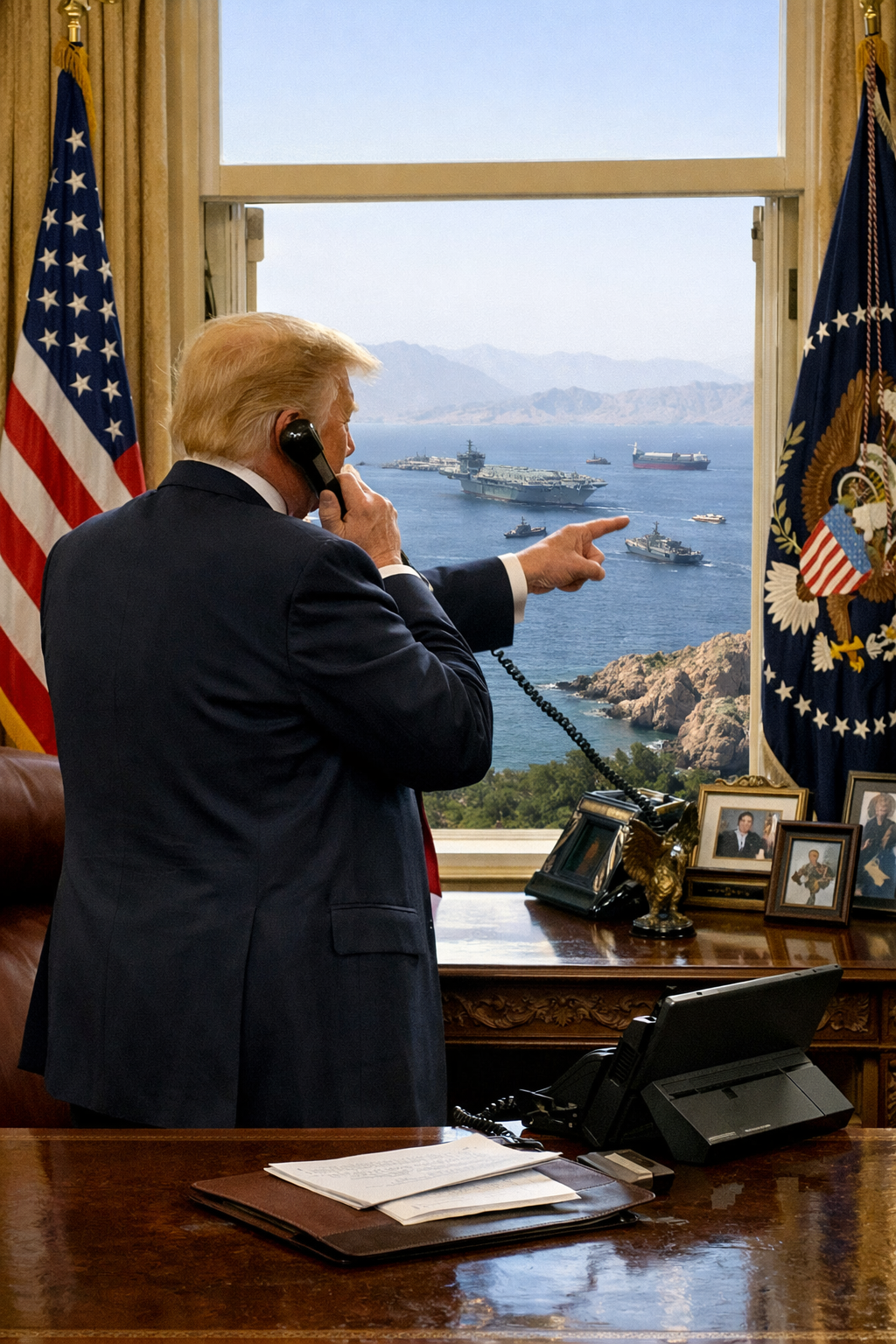
The threat of a confrontation around the Strait of Hormuz has once again moved from strategic theory to market reality. After the latest escalation involving Iran and renewed warnings from U.S. President Donald Trump about restoring free passage, the narrow waterway at the mouth of the Persian Gulf has returned to the centre of the global economy. What is at stake is not merely a shipping lane or a regional dispute. It is one of the world’s most consequential energy arteries, a corridor so critical that even the threat of disruption can lift prices, rattle insurers, and force governments from Asia to Europe into contingency mode.
The scale of the risk is difficult to overstate. According to the U.S. Energy Information Administration, 20.9 million barrels a day of oil moved through the Strait of Hormuz in the first half of 2025, equal to about 20 percent of global petroleum liquids consumption and roughly one-quarter of global maritime oil trade. The same route also carried 11.4 billion cubic feet a day of LNG, more than one-fifth of global LNG trade. The Congressional Research Service, in a March 2026 report prepared amid the present crisis, warned that a closure or effective interdiction of Hormuz would materially affect global supply and could trigger rapid price escalation in oil and petroleum products.
And, that’s because Hormuz is not a route the world can easily replace. The strait is only 22 nautical miles wide at its narrowest point, with two shipping lanes just two miles wide each, separated by a two-mile buffer.2 Bypass infrastructure exists, but only in part. The EIA estimates that Saudi Arabia and the UAE together may be able to divert around 4.7 million barrels a day via alternative pipelines in a disruption, while Iran’s own effective bypass capacity remains marginal. CRS presents a more conservative estimate for immediately available spare bypass capacity, at around 2.6 million barrels a day. Either way, the implication is the same: even with rerouting, a prolonged disruption would still leave a very large gap in world supply.
| What makes Hormuz critical? | Verified figure | Why it matters |
| Oil flows through the strait | 20.9 million b/d in 1H25 | Equivalent to about one-fifth of world petroleum liquids consumption |
| Share of global maritime oil trade | About one-quarter | A blockade would reverberate through seaborne energy markets |
| LNG flows through the strait | 11.4 Bcf/d in 1H25 | Threatens gas markets in Asia and beyond |
| Width at narrowest point | 22 nautical miles | Makes navigation vulnerable to mines, missiles, drones and interdictions |
| Key destination markets | China, India, Japan, South Korea = 74% of Hormuz crude/condensate flows | Asia would absorb the first and largest shock |
The immediate global effect of any serious Hormuz disruption would be felt through three channels at once: prices, freight, and confidence. First, crude prices would rise sharply as buyers scramble for non-Gulf supply and traders price in the risk of physical shortage. Second, shipping costs would climb because tankers entering the Gulf would demand higher compensation for war risk. CRS notes that insurance policies in the region often contain 72-hour cancellation clauses, enabling insurers to quickly reprice exposure; premiums, it says, have already moved to four or five times earlier levels during the current conflict environment. Third, markets would face a confidence shock. Even if some cargoes continue to move, the fear of missile strikes, drone attacks, or mining operations can itself be enough to slow traffic and push refiners to bid more aggressively for alternative barrels.
The global economy is particularly exposed because energy shocks do not stay confined to fuel markets. A sustained jump in crude prices would feed into inflation, transport costs, electricity generation, petrochemicals, fertiliser production and food prices. LNG disruptions would intensify the squeeze for import-dependent Asian buyers and could force them into a contest for spot cargoes. CRS further notes that the Gulf is also a critical outlet for commodities beyond oil and gas, including helium and fertiliser-related products, meaning the economic ripple effects would likely extend well beyond the energy complex.
How this development impacts India
For India, the story is slightly more complicated than the headline panic suggests. New Delhi’s official position is that crude supplies remain secure because procurement has become more diversified. In an inter-ministerial briefing on 11 March, the government said India now sources crude from around 40 countries, and that about 70 percent of crude imports are now routed outside the Strait of Hormuz, up from roughly 55 percent earlier. India’s daily crude consumption, the government said, stands at about 55 lakh barrels, and currently secured volumes exceed what would normally have arrived through Hormuz during this period.
That diversification is real, and it is important. It means India is less exposed on crude than in earlier decades. But it does not mean India is insulated. Official figures also show that India imports about 60 percent of its LPG consumption, and that roughly 90 percent of those LPG imports come through Hormuz. In other words, while crude may be better hedged geographically, household cooking fuel remains deeply vulnerable to disruptions in the Gulf. The same government briefing said domestic LPG production had been lifted by 25 percent through emergency measures, and that supplies are being prioritised for households and essential sectors. That is prudent damage control, but it is also an implicit acknowledgement of how quickly a maritime chokepoint can reach the Indian kitchen.
This is why the India angle is not just about whether cargoes physically arrive. It is also about price transmission. Even if New Delhi succeeds in sourcing crude from outside the Gulf, India still buys into a world oil market where benchmark prices are set globally. A Hormuz crisis therefore threatens India through landed import costs, currency pressure, fertiliser expenses, aviation turbine fuel prices, and eventually consumer inflation. It also complicates fiscal choices: the government can either absorb part of the pain through lower taxes or subsidies, or allow higher energy costs to filter through the economy.
There is also a strategic dimension. The EIA notes that Asian markets are the dominant destination for Hormuz energy flows, with China, India, Japan and South Korea accounting for a combined 74 percent of Hormuz crude and condensate traffic in the first half of 2025. That means any serious closure would not just be a Middle East crisis. It would be an Asian growth shock. For India, which is trying to sustain growth while keeping inflation and current-account pressures under control, this makes Hormuz both an energy security issue and a macroeconomic one.
The larger question, then, is whether the present crisis produces only a risk premium or a genuine supply shock. If the threat remains rhetorical and commercial traffic continues with naval escorts and higher insurance, the world may endure a period of elevated prices and volatility rather than outright scarcity. But if the confrontation deepens into sustained attacks on shipping, mining of sea lanes, or a prolonged closure, emergency stockpiles and spare capacity would only soften, not prevent, the shock. The International Energy Agency’s emergency mechanisms can help calm markets, and strategic reserves can buy time, yet even CRS warns that a prolonged disruption of Middle East oil trade would create conditions with little historical precedent.
For now, India has some buffers, but not immunity. The world has war-gamed Hormuz for decades because everyone understands the arithmetic: too much energy passes through too little water. Trump’s threat has revived the possibility that the arithmetic may once again become geopolitics. If it does, the economic consequences will not stop at the Gulf. They will travel with every tanker, every insurance policy, and every upward tick on a petrol pump in India.
References
The Guardian: Strait of Hormuz blockade threat explained
U.S. Energy Information Administration: World Oil Transit Chokepoints
Press Information Bureau: Inter-Ministerial Briefing held on Recent Developments in West Asia