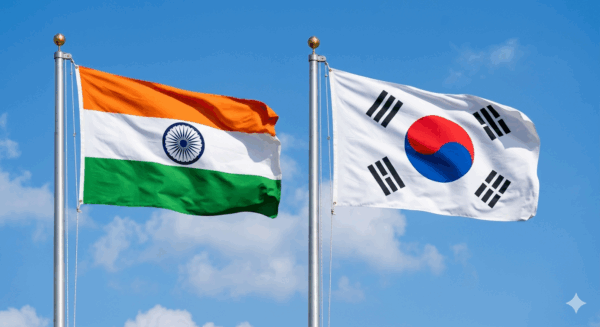
Sometimes, not often though, there are moments in foreign policy when the state catches up with society. Prime Minister Narendra Modi’s recent meeting with South Korean President Lee Jae Myung is one such moment and has produced the kind of headline that diplomats love and editors should not ignore: India and South Korea want to raise bilateral trade from $27 billion to $50 billion by 2030.
Planning to upgrade their trade agreement within a year, the two countries intend to deepen cooperation in semiconductors, shipbuilding, ports, steel, sustainability, artificial intelligence and supply chains, and launch new mechanisms such as an India-Korea Financial Forum, an Industrial Cooperation Committee, an Economic Security Dialogue, and an India-Korea Digital Bridge.1 2 This is no longer being pitched merely as a stable bilateral relationship, but as a move from a trusted partnership to a “futuristic partnership.”2
The labelling here matters as India and South Korea are not just trying to trade more goods; they are trying to inhabit each other’s future. And if the hard architecture of that future lies in chips, ships, industrial corridors and critical technologies, its emotional architecture may already have been built by K-dramas on smartphones, BTS playlists in college canteens, Korean ramen in Indian supermarkets, and the increasingly ordinary sight of young Indians learning Korean words before they ever set foot in Seoul.
Summit has arrived at the right cultural moment
The latest India–South Korea engagement is unusually broad in its ambition. According to the Ministry of External Affairs, President Lee’s visit was designed to push cooperation in shipbuilding, trade, investments, AI, semiconductors, critical and emerging technologies, people-to-people connect and cultural exchanges.1 Modi, for his part, explicitly linked economics with culture, saying that K-pop and K-dramas are becoming increasingly popular in India even as Indian cinema and culture are finding a wider audience in Korea.2
That is not ornamental diplomacy. It is an acknowledgement that the relationship has acquired a social base that did not exist in the same way a decade ago. The two countries have had institutional ties for decades, but they now also have a shared popular vocabulary. For a younger Indian audience, South Korea is no longer an abstract East Asian power known only through Samsung phones or Hyundai cars. It is also a cultural presence: intimate, aspirational, aesthetic, hyper-visible and emotionally legible.
This is precisely why the latest round of agreements deserves attention beyond the business pages. Trade treaties and industrial townships succeed more easily when countries are not strangers to one another. Soft familiarity lowers the psychological barrier to deeper engagement. It makes investment less alien, tourism more desirable, education partnerships more plausible, and political trust easier to sell domestically.
| Latest development | Why it matters |
| India and South Korea aim to raise bilateral trade to $50 billion by 2030 | Signals a major attempt to scale the economic relationship rather than merely manage it.2 |
| Both sides plan to upgrade the trade agreement within a year | Suggests dissatisfaction with the current pace and structure of commercial ties.2 3 |
| New cooperation frameworks span AI, semiconductors, shipbuilding, supply chains and finance | Shows the partnership is moving into strategic industries rather than remaining consumer-brand heavy.1 2 |
| Modi publicly highlighted K-pop, K-dramas and cultural ties | Indicates that cultural familiarity is now being treated as a strategic asset, not a side note.2 |
Why Korean culture found a home in India
The Korean wave in India is often reduced to trend language, as though it were simply a matter of teenagers copying skincare routines or binge-watching romantic series. That misses the depth of the phenomenon. A February 2026 India Today report argued that Korean culture’s rise in India is not a sudden obsession but the result of a slow cultural alignment spanning drama, music, food, fashion and language learning. It suggested that Korean content resonates because it speaks to family structures, emotional needs, aesthetics, gender representation and everyday habits in ways that feel fresh without being culturally unreachable.4
A 2023 research paper on K-pop and K-dramas among Indian youth makes a related point in more empirical terms. It notes that K-drama viewing in India rose sharply during the pandemic, citing a more than 370 percent increase in 2020 over 2019, and argues that social media and OTT platforms became major channels through which Indian youth encountered Korean culture.5 The study’s survey findings suggest that younger viewers were drawn not only by styling and trend value, but also by emotional storytelling and the sense that Korean content offered both escape and relatability.5
Another 2024 study of Indian youth and the Korean wave found that among the Hallyu elements it examined, Korean music was the most consumed, followed by Korean dramas, while Korean food showed a particularly strong correlation with the desire to travel to South Korea.6 That is a remarkable clue. It means the Korean wave in India is not only a streaming phenomenon. It is converting entertainment into appetite, appetite into curiosity, and curiosity into mobility.
This is where the politics of youth culture intersects with statecraft. Young Indians are not simply consuming Korean content; many are building miniature personal bridges to Korea through food, language, fashion, beauty products, fandom networks, travel ambitions and digital communities. Cultural consumption, in other words, is becoming a form of pre-diplomatic familiarity.
The northeast, the pandemic, and the widening of the Korean wave
It is also important not to tell the story as though Korea arrived in India only through metropolitan streaming culture. Scholars have long noted the role of India’s northeast as one of the earliest gateways for the Korean wave. The 2024 study on Indian youth’s intention to visit South Korea describes the northeast as an early zone of Hallyu penetration, while the broader literature cited in recent Indian research traces the popularity of Korean dramas and music in the region back to the early 2000s.5 6
What changed in the last few years was scale. The pandemic flattened cultural distance. Locked indoors, millions of Indians crossed the so-called one-inch barrier of subtitles and discovered that Korean storytelling could feel both foreign and intimate at once.5 Streaming platforms amplified that discovery, recommendation cultures turned viewers into evangelists, and social media transformed scattered fandoms into visible communities. Soon, Korean food was no longer just a niche urban indulgence, K-beauty was no longer a specialist import, and Korean phrases no longer sounded obscure to middle-class Indian students.
This widening matters for diplomacy because it means India’s Korea moment is no longer geographically or socially marginal. It is broadening into the mainstream, particularly among the young, the urban, the digitally connected and the culturally experimental. These are precisely the social cohorts that shape consumption, travel, education choices and future professional networks.
If the cultural present gives the relationship warmth, the historical past gives it depth. Official Indian accounts of the bilateral relationship emphasise that India and Korea share ancient civilisational links. One of the most enduring legends, recorded in the Korean text Samguk Yusa, is that Princess Suriratna of Ayodhya travelled to Korea in AD 48 and married King Kim Suro, becoming Queen Heo Hwang-ok.1 3 This story sits somewhere between history, memory and identity, but its symbolic power in both countries is undeniable.
There are other, firmer threads. The Embassy of India in Seoul notes that the Buddhist monk Hyecho travelled through India in the eighth century and left behind a travel account that remains an important record of the subcontinent.3 Rabindranath Tagore’s 1929 poem, “Lamp of the East,” became another enduring bridge, offering Koreans a language of civilisational dignity during a period of occupation and struggle.3 And after Korean independence, India played a significant role in Korean affairs: K.P.S. Menon chaired the UN commission related to elections in Korea, India sponsored a resolution accepted by both sides during the Korean War, the 60th Indian Parachute Field Ambulance Unit served with distinction, and General K.S. Thimayya later chaired the Neutral Nations Repatriation Commission.3
These details matter because they rescue the relationship from presentism. India and South Korea are not strangers discovering each other through Netflix. They are older acquaintances whose historical connections were once thinly institutionalised and are now being rediscovered in a new geopolitical and cultural context.
An ORF analysis on India–South Korea relations argued that the bilateral relationship can be significantly strengthened by building on civilisational connections, people-to-people contact, cultural relations and shared democratic values.7 That is exactly the lesson of the current moment. Agreements on semiconductors and supply chains are essential, but they are also vulnerable to bureaucratic drift if the wider relationship remains elite-led. A socially rooted partnership is harder to neglect.
This is where the Indian youth’s embrace of Korea becomes strategically important. It can expand tourism, encourage language study, strengthen university exchanges, widen the market for cultural collaborations, deepen business familiarity, and create a generation that sees South Korea not as a distant strategic node but as a real country with emotional, cultural and economic relevance. Seoul, for its part, has long understood the export value of culture. India is now in a position to convert that soft-power familiarity into a denser bilateral compact.
The challenge is not lack of affection. It is institutional imagination. If both governments are serious, the current summit should be followed by co-productions, student mobility schemes, culinary festivals, academic partnerships, startup corridors, translation initiatives and easier pathways for youth travel and professional exchange. The planned India-Korea Friendship Festival in 2028 is a useful signal, but it should be the beginning, not the climax.2
For years, India–South Korea relations have been described as promising, under-realised and somehow always on the verge of becoming more consequential. That diagnosis may still be true. But it is less true than before.
The latest summit has supplied strategic urgency. The global economy has supplied the logic of supply-chain diversification. Technology competition has supplied the sectors of cooperation. And culture has supplied something politics rarely manufactures on its own: desire.
That may be the most important story here. At the very moment New Delhi and Seoul are trying to upgrade trade, build digital bridges, deepen industrial ties and imagine a more ambitious strategic future, millions of young Indians are already living, in fragments, inside a Korean cultural universe. They are listening, watching, tasting, imitating, learning and dreaming across borders.
Foreign policy usually begins in ministries. Sometimes, however, it arrives earlier in playlists, subtitles and food cravings. India and South Korea would be wise to notice that the future of their partnership may not be built only in boardrooms and summit halls. Part of it is already being rehearsed in the cultural life of India’s young.