At 17, the Coimbatore sprinter has already broken India’s Under-18 100-metre record twice in one afternoon. The more revealing part of his story is what happened before and after the stopwatch stopped.
The first thing Neil Samraj noticed was not the applause. It was the part of the race he felt he had got wrong.
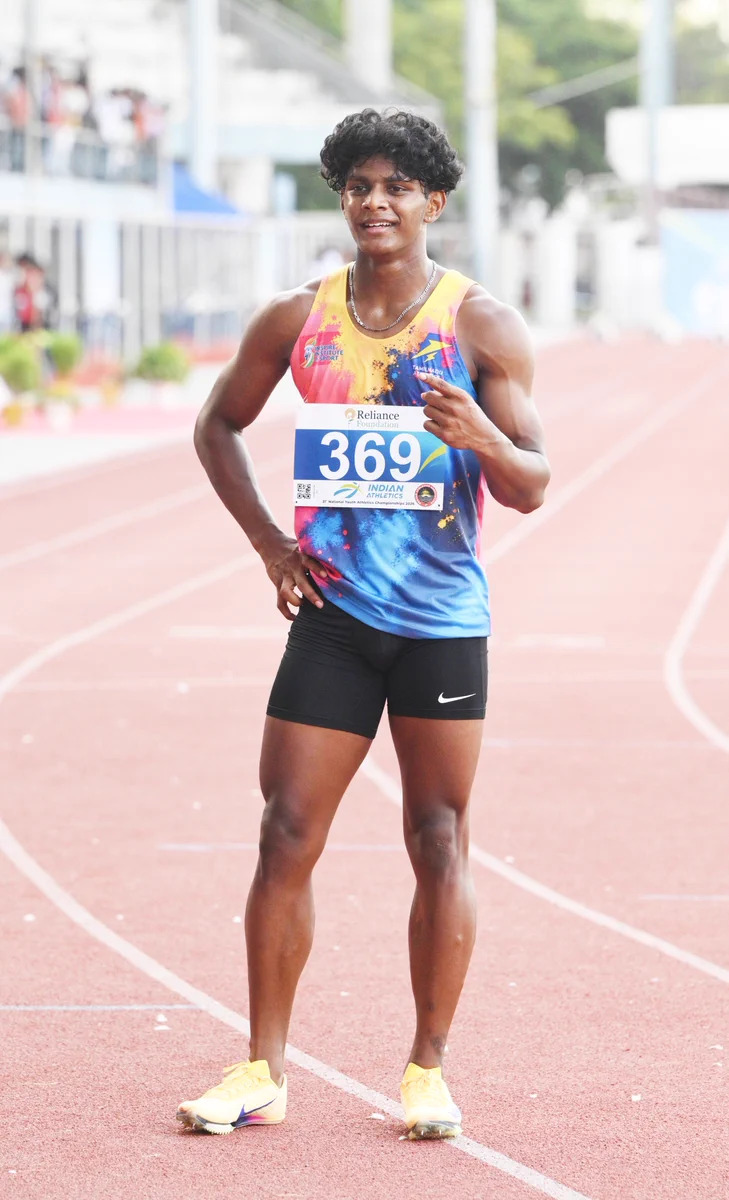
On September 1 at Ludhiana’s Guru Nanak Stadium, the 17-year-old from Coimbatore ran 10.46 seconds to win the men’s Under-18 100 metres at the 21st National Youth Athletics Championships. The time was not merely a victory. It was a national record and a meet record, according to the Athletics Federation of India’s official results. [1] World Athletics lists the performance as Samraj’s personal best and the fastest 100-metre mark recorded on his athlete profile. [2]
Yet Samraj’s own assessment of the race was less triumphant than the result suggested. He had hoped to run below 10.40 seconds. He had been carrying a cold. And, as he later explained, he tightened towards the end of the final. The number on the clock said 10.46. The athlete’s immediate response was that there was more in him.
That tension—between a record-breaking performance and the conviction that it can be improved—is at the centre of Samraj’s emergence. He is not being presented simply as a teenager who ran one extraordinary race. He is a young sprinter learning how to convert speed into repeatable performance, how to move from junior promise to senior competition, and how to carry ambition without allowing it to outrun development.
A record fell twice
The final in Ludhiana was the second time Samraj had rewritten the national benchmark that day. In the semifinal, he clocked 10.53 seconds into a headwind of 0.6 metres per second, breaking the previous Under-18 national record of 10.63 seconds set by Anshu Rajak in 2023. In the final, he went seven hundredths faster. Sportstar reported that Samraj’s start was strong and that he covered the next 30 metres well, but lost some smoothness late in the race. [3]
The official results place Samraj first in the final in 10.46 seconds, ahead of West Bengal’s Mehebubul Ahamed, who ran 10.74, and Delhi’s Pushpendar Kumar, who ran 10.81. The performance earned Samraj 1,053 points under the World Athletics scoring tables used for the meet. [1]
| Milestone | Performance | Significance |
| 100m semifinal, Ludhiana | 10.53 seconds | New Under-18 national record; run into a 0.6 m/s headwind |
| 100m final, Ludhiana | 10.46 seconds | Gold medal, Under-18 national record and meet record |
| Previous U18 national mark | 10.63 seconds | Set by Anshu Rajak in 2023 |
| 4x100m relay, 2026 | 41.01 seconds | World Athletics-listed personal best for Samraj’s relay record |
| 200m, 2026 | 21.73 seconds | World Athletics-listed personal best |
The result also gave Tamil Nadu a sweep of the youth 100-metre titles in Ludhiana. T. Mrithika won the women’s Under-18 100 metres, making it a memorable meet for the state’s sprint programme. [4]
For Samraj, however, the record was not the finish line. “The target was to clock sub-10.40 in the finals,” he told The Indian Express, explaining that he had been unwell and had not fully recovered between the semifinal and final. [5] Sportstar reported a similar assessment: Samraj believed a cleaner race could take him into the 10.3-second range. [3]
It is a bold claim, but not an empty one. The 10.46 came after a season in which his performances had moved sharply forward. Just months earlier, the gap between his ambitions and his clock was considerably larger.
From school races to a serious pursuit
Samraj grew up in Venkatapuram, Coimbatore, in a family where sport was already familiar but not yet a professional plan. His father works in banking and his mother is a government school teacher. His elder sister, Nedra, was also a sprinter and won medals in the 100 metres at Tamil Nadu state-level competitions. [3]
That family connection mattered. When Samraj began to take running seriously, his parents understood that the interest was more than a passing fascination. The New Indian Express reported that a few YouTube videos of sprinters changed his outlook. He had initially run because school competitions were enjoyable and because sprinting gave him an adrenaline rush. Around Class IX, the activity began to look like a possible future. [6]
The transformation was gradual. There was no childhood mythology of a prodigy who knew from the beginning that he would become a sprinter. Instead, there was a teenager watching athletes run, recognising something in their movement, and deciding that he might be capable of joining them.
“I began by simply running whenever there were competitions at school,” Samraj told Sportstar. “Slowly, the interest kept growing.” [3]
The family’s decision to support that interest came with practical difficulties. Competition meant travel, accommodation, equipment and time away from ordinary routines. Sportstar reported Samraj saying that his parents sometimes had to borrow money or make other adjustments to support the athletics commitments of both children. [3] The New Indian Express similarly reported that the family was not financially strong, but helped him pursue sprinting in whatever ways it could. [6]
The details are important because young athletes are often described through their results while the cost of reaching those results disappears from view. A national record is measured in hundredths of a second. The road to it is usually paid for in years, transport, recovery, coaching, missed opportunities and family sacrifice.
The coach who changed the rhythm
Samraj met Velmurugan in 2020 while training at Coimbatore’s Nehru Stadium. Their relationship began as a conventional coach-athlete arrangement and developed into a partnership that has shaped both his technique and his approach to competition. Velmurugan runs Unique Sports Academy in Coimbatore and has worked with Samraj for roughly four years. [3] [5]
The early version of Samraj was not yet the disciplined sprinter now visible in national results. The Indian Express reported that he trained only two or three days a week and was not fully focused. Velmurugan told the paper that he saw fast-twitch potential in the youngster and convinced him that medals were possible. After that conversation, Samraj’s attitude towards training changed. [5]
The significance of the episode lies less in the phrase “fast-twitch muscles” than in the coach’s decision to treat potential as something that required belief before it produced evidence. A teenager who only occasionally attended training had to imagine himself as an athlete before he could begin behaving like one.
Velmurugan’s influence has also survived distance. After the Reliance Foundation identified Samraj at the Junior School Nationals, Samraj began dividing his time between the Foundation’s Mumbai setup and Coimbatore. When he is away, Velmurugan sends his programme by phone. Samraj completes the sessions, sends videos and timings, and discusses any problems with the coach the next morning. When he returns to Coimbatore, the training becomes direct and full-time again. [3]
The arrangement reflects the reality of developing an elite sprinter in India. The athlete may need better facilities, specialist support and access to recovery systems, but the relationship with the coach who knows his habits and weaknesses remains central. In Samraj’s case, the two systems have not replaced each other. They have been layered together.
Samraj’s 2026 season was not a straight line from promise to record. The New Indian Express reported that he began the year with a personal best of 10.68 seconds. At the Junior Federation Athletics competition in Bengaluru in April, he suffered a hamstring injury and missed the Junior Asian Championships. [6]
The injury introduced a different kind of test. Sprinting is often presented as the art of maximum effort, but progress also depends on restraint: knowing when to push, when to recover and when to allow the body to return. Samraj recovered at the Reliance Foundation’s Mumbai facility. He said the support he received during that period was as important as the training itself. [6]
After returning to competition, he ran 10.56 seconds in the men’s Under-20 final of the Indian Open Athletics Series in Pune in June, according to The New Indian Express. He then ran 10.59 in the Thiruvananthapuram leg of the open series. Sportstar also identified 10.59 as the personal-best level he had reached before the Ludhiana breakthrough. [3] [6]
The official World Athletics profile records another dimension of his development: a 21.73-second personal best in the 200 metres, dated April 25, 2026. It also lists his 4×100-metre relay best as 41.01 seconds, recorded on August 8. [2] These events matter because a 100-metre sprinter’s development is not contained in one race. Acceleration, speed maintenance, relay responsibility and the ability to repeat performances across rounds all become part of the athlete’s education.
A first lesson on the world stage
In August, Samraj travelled to Eugene, Oregon, for the World Athletics Under-20 Championships as part of India’s men’s 4×100-metre relay team. Running the anchor leg, he helped the quartet finish sixth in its heat in 41.01 seconds, according to Sportstar and the World Athletics performance record. India did not progress to the next round. [2] [3]
For a 17-year-old whose biggest breakthrough was still ahead of him, the experience offered a different kind of achievement. It exposed him to the scale and pressure of international competition before he had fully arrived as an individual sprinting name.
Samraj told Sportstar that the main lesson was learning to handle pressure without becoming distracted. He also valued the opportunity to watch other athletes and compete at a level beyond the domestic circuit. [3]
That education may prove as important as the time itself. Junior athletes can dominate local fields and still struggle when the setting changes, the rounds come quickly, and every competitor has arrived with a serious claim. The relay placed Samraj inside that environment. Ludhiana then tested whether he could bring what he had learned back to an individual event.
The technical advice surrounding Samraj is notably measured. James Hillier, the Athletics Director at Reliance Foundation, told The Indian Express that Samraj is generally solid but needs to improve the first 30 metres, particularly his first three steps and the way he sets up the race. Hillier’s immediate objective is not to force him towards 10.2 or 10.3 seconds at any cost. It is to make 10.40-level running consistent. [5]
That is the distinction between a spectacular junior result and a sustainable career. A single fast time can come from favourable preparation, a strong field, a good start or a particular emotional moment. Reaching the same level repeatedly requires mechanics that survive fatigue, pressure and changing conditions.
Hillier also praised Samraj’s openness to coaching. The quality is easy to underestimate. A young athlete who has just broken a national record can decide that the result proves he already knows enough. Samraj appears to be taking the opposite lesson: the record shows that the work is succeeding, but it also reveals where the race can still be improved.
His own comments carry the same combination of confidence and uncertainty. He speaks openly about breaking the record again, but he also acknowledges that training must be executed on the track, that execution does not always work perfectly, and that mistakes have to be corrected. [3]
Dakar, and the problem of becoming senior
Samraj’s immediate ambition is the Youth Olympic Games in Dakar, scheduled for November 2026. Before that, he expects to encounter several more tests, including the Junior Nationals in Chennai, Khelo India and the All India University Games. The New Indian Express reported that he hopes to break the national record again and run below 10.40 before the Dakar event. [6]
He is also a first-year BA History student at Loyola College. The Indian Express reported that his longer-term aim is not merely to remain a successful junior athlete, but to become more consistent when he moves into the senior ranks and to win medals for India. [5]
The transition from junior to senior athletics is where many promising careers become complicated. The bodies change, the competition deepens and the margins become narrower. The Under-18 record is a marker of where Samraj stands among athletes his age; it is not a guarantee of senior success. World Athletics’ profile places his 10.46 within his current record, but the next phase will be about building the physical durability, technical consistency and competitive experience needed to carry that speed forward. [2]
For now, the most encouraging sign is not only the record. It is the way Samraj talks about what comes next. He is ambitious enough to describe a 10.3-second future, disciplined enough to continue listening to his coaches, and self-critical enough to see flaws in a race that the rest of the country saw as historic.
The stopwatch has already made him India’s fastest Under-18 100-metre runner. The harder task is to make that speed repeatable—to run the same race when the headwind is different, when the body is tired, when the field is stronger, and when the expectations are no longer a surprise.
References
[2]: World Athletics — Neil Samraj athlete profile
[4]: Athletics India — “Vishnu, Oshin and T. Mrithika Shine at Youth Nationals 2026”
[5]: The Indian Express — “Neil Samraj ran 10.46 at 17. His reaction tells you everything”
[6]: The New Indian Express — “Hope to lower national record before Youth Olympics: TN sprinter Neil”
Editorial note
The article uses the official Athletics Federation of India results and the World Athletics profile for the 10.46-second final and other performance data. The New Indian Express report contains an apparent internal inconsistency in its description of the final time; where accounts differ, this feature follows the official result and the independently corroborating reports from Sportstar and The Indian Express.
At 17, Neil Samraj has broken the record twice in one day. His career will be defined by what he does with the third opportunity.