In Son Gudda, a village in Madhya Pradesh’s Balaghat district, the nearest city is not simply a destination. It is a measure of time, distance and risk. The village is about 70 kilometres from Balaghat town, according to a field report published by independent journalist Monika Singh. Her report describes a primary health system without dependable ambulance access, patients being transported together in a single vehicle and local health centres that, she says, did not have even basic malaria treatment available. [10] [11]
That distance has become central to a public-health crisis in the district’s remote Adivasi belt. Since late May and June, children from Baiga and Gond communities have fallen ill and died in villages including Bondari, Matla, Machhurda, Korka, Kundekasa and Adori. The number of deaths is fiercely disputed. Local residents and Opposition leaders have spoken of 27, 29, 30 or even 31 children. Government figures cited at different stages have been lower, beginning with seven or eight deaths and later rising in separate accounts. A health-department review accessed by Scroll listed 25 deceased children, while a senior Union health official told The Hindu that the formal review of reported deaths was still continuing. [1] [3] [8]
The disagreement over the number is not a technical footnote. It is the story. When a death is not promptly registered, when a child dies at home without medical attention, when families live beyond the reach of an ambulance, and when health records do not match village testimony, counting becomes part of the public-health system. A child who is not counted is harder to investigate, harder to compensate for and easier for the state to overlook.
A crisis that travelled village by village
The first reports emerged from villages in the Birsa and Baihar areas. A report by ETV Bharat on August 12 recorded seven child deaths over roughly 40 days and said that 96 seriously ill children had been sent to hospitals; 51 had been discharged while 45 remained under treatment at that stage. The report named malaria, typhoid, cholera, fungal infection and other illnesses among the concerns being examined, while also recording uncertainty among officials about the precise causes. [7]
By August 18, ETV Bharat reported that residents in several villages were putting the toll at 19 and alleged that nutritional supplements had not been distributed for almost six months. The report described villages inhabited by Baiga and Gond communities, poor access to clean water and healthcare, and the particular vulnerability of children living in remote forest settlements. It also noted that Balaghat had been a major malaria hotspot in Madhya Pradesh. [6]
The field investigation by Scroll presents a still more troubling chronology. It reported that three children died in Matla in May, followed by four deaths in June and three more in July in other villages of the Birsa block. After the ninth death on July 22, the health department began to respond more visibly. Of 25 deceased children listed in departmental records accessed by Scroll, only nine had received some medical attention in a government or private hospital. In the first seven cases examined by the publication, the children—aged between one and 12—had died at home without medical care. [1]
The implication is not that every death could certainly have been prevented. It is that many children were ill for weeks, and that the line between illness and death was crossed in settlements where timely medical attention was difficult to obtain. In one village, Scroll found no functioning ASHA worker—the accredited social health activist who is supposed to serve as the first link between rural families and the health system. It also found that auxiliary nurse midwives and other frontline personnel were absent from villages it visited. [1] The absence of care was compounded by the absence of infrastructure. Residents told Scroll that there were no usable roads to some settlements and that sick people sometimes had to be carried on bamboo poles. A family could therefore face several delays at once: recognising the seriousness of an illness, finding a vehicle, reaching a health centre and obtaining treatment after arrival.
The medical picture is complex—and that matters
The public debate has often compressed the crisis into a single phrase: a measles or malaria outbreak. The official medical picture is more complicated. The Union Health Ministry and the Madhya Pradesh government have cautioned against attributing all the deaths to one pathogen. A senior Union health official told The Hindu that investigators were examining the combined role of measles, malaria, respiratory illness, malnutrition, anaemia, dehydration and delayed access to treatment. [3]
This distinction is essential. It does not make the crisis less serious; it makes the accountability question more precise. If the deaths were caused by a combination of infections and nutritional vulnerability, then responsibility cannot be reduced to whether one laboratory test was positive. It must include vaccination, nutrition, clean water, vector control, early detection, referral transport, medical staffing and the recording of deaths.
The reports also point to the way malnutrition can turn a treatable infection into a fatal illness. Dainik Bhaskar English reported that a Central screening exercise examined 32,433 people, found 7,711 children severely malnourished, and sent 518 children to nutrition rehabilitation centres. It also reported 13,406 children with diarrhoea and 274 with severe pneumonia. These figures require continued official verification, but they help explain why the health crisis cannot be understood as a narrow disease outbreak. [8]
A follow-up investigation by Scroll found that the measles-immunisation record and the family’s account did not always match. The father of one deceased child said none of his children had been immunised, while an anganwadi record showed that the child had received one measles dose along with Vitamin A and a pneumococcal vaccine. The local anganwadi worker said she had joined after the entry was made and that no vaccination rounds had been conducted since she began work. A teacher at a nearby primary school told Scroll he had repeatedly asked the health department to vaccinate children. [2]
Such discrepancies are not proof of deliberate falsification. They are, however, a reason for an independent audit of immunisation and nutrition records. A register is only as reliable as the system that updates it, and a programme that exists on paper but does not reach a village is not a functioning programme.
What reporters found on the ground
Monika Singh’s public reporting gives the crisis a geography. In a September 2 post published through The Unsalted and linked to her account, she described Son Gudda as a village around 70 kilometres from the city, with an inadequate health system, no reliable ambulance access and patients being transported together to Balaghat. The caption said that several tribal villages were affected and that deaths were being linked in local reporting to measles, malaria and malnutrition. [10] [11]
The report should be read as field testimony and a journalist’s account of what she observed and was told—not as a substitute for medical records. Its value lies in showing how a state health response is experienced at village level. A mobile medical unit can be counted in an official statement; a family waiting for transport, or being forced to share a vehicle with several patients, describes what access means in practice.
The publicly indexed profile associated with Singh also carried posts describing crowded hospital conditions, including claims that three patients were being placed on a single bed, and a post asking how a child named Ranjeet died when the family had still received no clear answer. Another post referred to the administration’s delayed response after the deaths. These claims require documentary and on-record verification, but they are relevant leads for a reporting team investigating hospital capacity, case records and communication with families. [10] Singh’s reporting also became part of a second story: what happened to journalists who travelled to Balaghat. Her profile displayed material referring to the temporary suspension of social-media accounts belonging to her and fellow reporters. That issue was later reported by Scroll and addressed by the Press Club of India. [9] [10]
Bindu Romi Gurjar’s public Instagram profile identifies her as a journalist and links to a YouTube account. The Balaghat posts indexed on the profile raise two specific lines of inquiry. One post questioned the shortage of staff at district hospitals and primary health centres and asked why doctors and other health workers had allegedly been transferred out of tribal areas during the preceding three months. Another post focused on Preeti, described as a three-year-old child whose six-member family received only 10 kilograms of ration each month; it also referred to the Chief Minister acknowledging that government schemes had not reached the ground, while attributing the gap to the difficulties created by Naxal-affected areas. [12]
These posts should be treated as the reporter’s field leads and attributed claims, not as independently settled findings. They point to documents that can and should be obtained: sanctioned and vacant posts at the relevant health centres, transfer orders, attendance registers, ration-allocation records and the names of families who did or did not receive supplementary nutrition. If the staffing transfers occurred as described, they would be directly relevant to the question of whether the outbreak was detected and treated in time.
The YouTube link displayed in Gurjar’s Instagram biography resolved, during review, to a different report unrelated to Balaghat. It has therefore not been used as evidence for this article. The Balaghat claims attributed to her here come from the publicly indexed posts on her reporting profile, while the wider health findings are cross-checked against independent reports by Scroll, The Hindu, ETV Bharat and NDTV. This distinction matters: a credible feature must not turn a search result, hashtag or third-party upload into a reporter’s testimony.
Protest video captured the dispute in real time
A directly verifiable YouTube field report came from Lok Singh, whose channel, Beyond The Script, describes him as a journalist doing ground reporting on issues often ignored by mainstream media. In a 1 minute 16 second video titled “MP: Why Are Adivasis Protesting in Balaghat? 27 Children’s Deaths Raise Questions,” Singh reported from a protest site. [13]
In the video, Singh said protesters alleged that 27 Baiga children had died between June and August because of administrative negligence, with malaria, measles and malnutrition being cited. He contrasted that claim with an official figure of eight deaths. He also reported protesters’ claim that 50 to 60 tribal children remained hospitalised and that the demonstration had continued for eight days. The video shows a group of protesters seated under a tent-like structure, with a banner referring to the Adivasi community and a hunger strike. [13]
Every part of that account requires attribution. The visible protest is a direct observation. The 27-death toll, the allegation of administrative negligence, the medical causes and the number of hospitalised children are claims made by protesters or reported by the journalist. They become more significant because they align with the broader pattern independently documented by national and regional reporting, but they should not be presented as settled official facts.
The value of Singh’s video is that it captures the political meaning of the disputed count. For families and protesters, the number is not an abstract statistic. It is an argument that the state did not see—or did not acknowledge—the scale of what was happening until public pressure made silence impossible.
The government response came, but a bit too late
The state response has been substantial, according to government figures reported by The Hindu and NDTV. A National Joint Outbreak Response Team was deployed on August 12. The response involved ICMR teams, clinical and laboratory assessments, measles and malaria surveillance, mortality review, entomological investigation, mobile medical units, vaccination, vector control, safe-water measures and nutrition interventions. [3] [4]
By the time of the September 5 reporting, more than 32,400 people had reportedly been medically examined. The government said 431 children had been admitted to health facilities, 379 had been discharged and 52 remained under treatment or observation. An additional measles-rubella dose had been given to 14,637 children aged between one and 10 years. More than 600 drinking-water sources had been purified and insecticide spraying had been completed in 4,338 households. Officials said no new measles case had been reported in the preceding seven days. [3] [4]
The response also included political and administrative action. The Statesman reported that Chief Minister Mohan Yadav visited Balaghat on August 29 and announced ₹2 lakh compensation for each bereaved family. It also reported the removal of Balaghat’s Chief Medical and Health Officer, along with the removal of the district malaria officer and vaccination officer after a visit by the Health Minister and Deputy Chief Minister. [5]
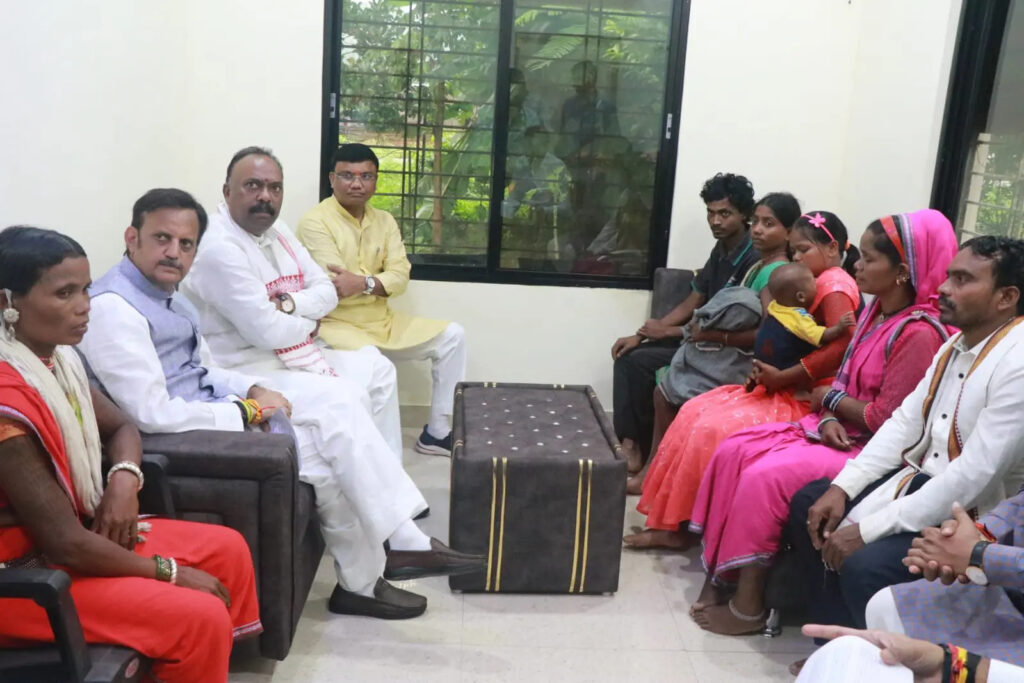
For families and tribal organisations, however, the compensation was not enough. Hundreds of tribal people reportedly joined an indefinite strike and called a bandh in Balaghat. Their demands included better medical facilities and action against officials responsible for the spread of disease and the deaths. The protest raised a question that compensation alone cannot answer: whether a state should compensate a family after a child dies without first explaining why basic services failed to reach that child in time. [5]
The government’s position, as reported by The Hindu and NDTV, is that the crisis has multiple causes and that the situation improved after an intensified response. That account must be included. It does not, however, resolve the earlier questions about delayed detection, vaccination gaps, nutrition distribution, staff shortages, transport and the conflicting death tolls.
When the reporters became part of the story
On September 8, Instagram temporarily suspended the accounts of Monika Singh, Bindu Gurjar and Lokbhadra Singh, according to Scroll. Their accounts were restored two days later. The journalists had been reporting on the child deaths, Adivasi protests, alleged hospital mismanagement and the difficulties faced by ASHA workers. [9]
The Press Club of India condemned the suspensions and called for an impartial examination of the circumstances. According to the statement quoted by Scroll, the journalists said district officials repeatedly pressured them to meet privately; after they declined, they were allegedly asked to vacate their hotel rooms. The Press Club also said they were allegedly followed by plainclothes police and that their movements were monitored for two days. [9]
Those allegations need responses from the district administration, Madhya Pradesh Police, Instagram/Meta and the journalists themselves. A temporary account suspension may be an automated platform action, a complaint-driven action or something else; without Meta’s explanation, its cause cannot be established. Similarly, pressure, questioning and surveillance are serious allegations that should be documented through notices, station diary entries, hotel records, messages and first-person testimony.
But even before those questions are finally answered, the episode illustrates why the health crisis requires scrutiny beyond official press releases. Reporting from remote tribal settlements is often the mechanism by which a local emergency becomes visible nationally. When the reporters’ access to public platforms is interrupted, the public loses more than three accounts: it loses a route to evidence that may never enter the formal record.
The count the state must publish
The immediate demand should not be another competing estimate. It should be a transparent, child-by-child reconciliation of the deaths.
| Question | What must be made public |
| Who died? | Names or protected case identifiers, age, village, date of death and family contact, with privacy safeguards. |
| Where did each child die? | Home, primary health centre, district hospital, private hospital or elsewhere. |
| What was the medical finding? | Clinical diagnosis, laboratory results, post-mortem or mortality-review findings where available. |
| What care was available? | Vaccination history, nutrition status, ASHA/ANM contact, referral, ambulance access and treatment timeline. |
| What did the state know and when? | First notification, surveillance reports, outbreak-team deployment and action taken after each alert. |
| What support reached families? | Compensation, nutrition assistance, medical follow-up and grievance mechanisms. |
Until that register is released, the public is left with several numbers and no common evidentiary base. The difference between eight, 25, 27, 29, 30 and 31 cannot be dismissed as political noise when every number represents a different account of how many families have lost children and how quickly authorities responded.
A preventable crisis is not the same as a simple one
The Balaghat story should not be reduced to a clash between a government number and an Opposition number. Nor should it turn tribal communities into passive subjects of tragedy. Families identified the deaths, protests demanded answers and independent reporters travelled to villages that had received little sustained national attention.
Nor should the state’s explanation be caricatured. The government has deployed outbreak teams, increased screening, vaccinated children, purified water sources, sprayed households, expanded treatment capacity and announced compensation. The medical evidence points to a complex mix of infection, malnutrition and access barriers rather than one simple cause. Those facts belong in the story.
The accountability question is therefore more demanding: why did these measures arrive after children had already died, and why did the state’s count lag behind the communities’ experience?
Balaghat’s children were not lost to one mysterious disease alone. They were endangered by distance, hunger, incomplete prevention, delayed care and an uneven state presence. The final measure of the government response will not be the number of teams deployed after the headlines. It will be whether a child in Son Gudda, Bondari or Matla can receive vaccination, nutrition, transport and treatment before the next family has to begin counting.
Editorial note: This feature distinguishes between verified government data, independent reporting, direct observations by field reporters, and claims made by families, protesters or political actors. The death toll and some allegations concerning administrative pressure on journalists remain disputed or require further documentary verification.
References
[4]: NDTV — “Balaghat Outbreak: No New Measles Case In 7 Days Says Centre Amid Recent Deaths”
[5]: The Statesman — “Tribals question 2 lakh compensation for deaths of kids”
[6]: ETV Bharat — “19 Children Die In Balaghat As Malnutrition, Disease Raise Alarm”
[7]: ETV Bharat — “Balaghat: 7 children die in 40 days; health teams alerted”
[9]: Scroll — “Instagram accounts of three journalists reporting on MP child deaths briefly suspended”
[10]: Monika Singh — public Instagram profile, @monikasingh_unsalted
[11]: Monika Singh / The Unsalted — “Balaghat’s Son Gudda village is about 70 km from the city”
[12]: Bindu Romi Gurjar — public reporting profile, @samachar_by_bindu